
Deposit and Pro Forma Invoices: How to Bill Your First Wholesale Orders
You've taken your first wholesale orders and need money in before you pay your supplier. Here's what to send the buyer, in what order, and what goes on each.
 Joe Lauder·Founder, Kōbō·Updated Nov 2, 2026
A deposit invoice bills part of a confirmed order up front, so you're paid something before you pay your supplier. The balance invoice bills the rest later. A pro forma is different: a quote in invoice format, with no invoice number, that shows what's due but doesn't create a debt. Send the order confirmation first, then the deposit invoice (and a pro forma if the buyer needs one to arrange funds), then the balance.
What is a deposit invoice?
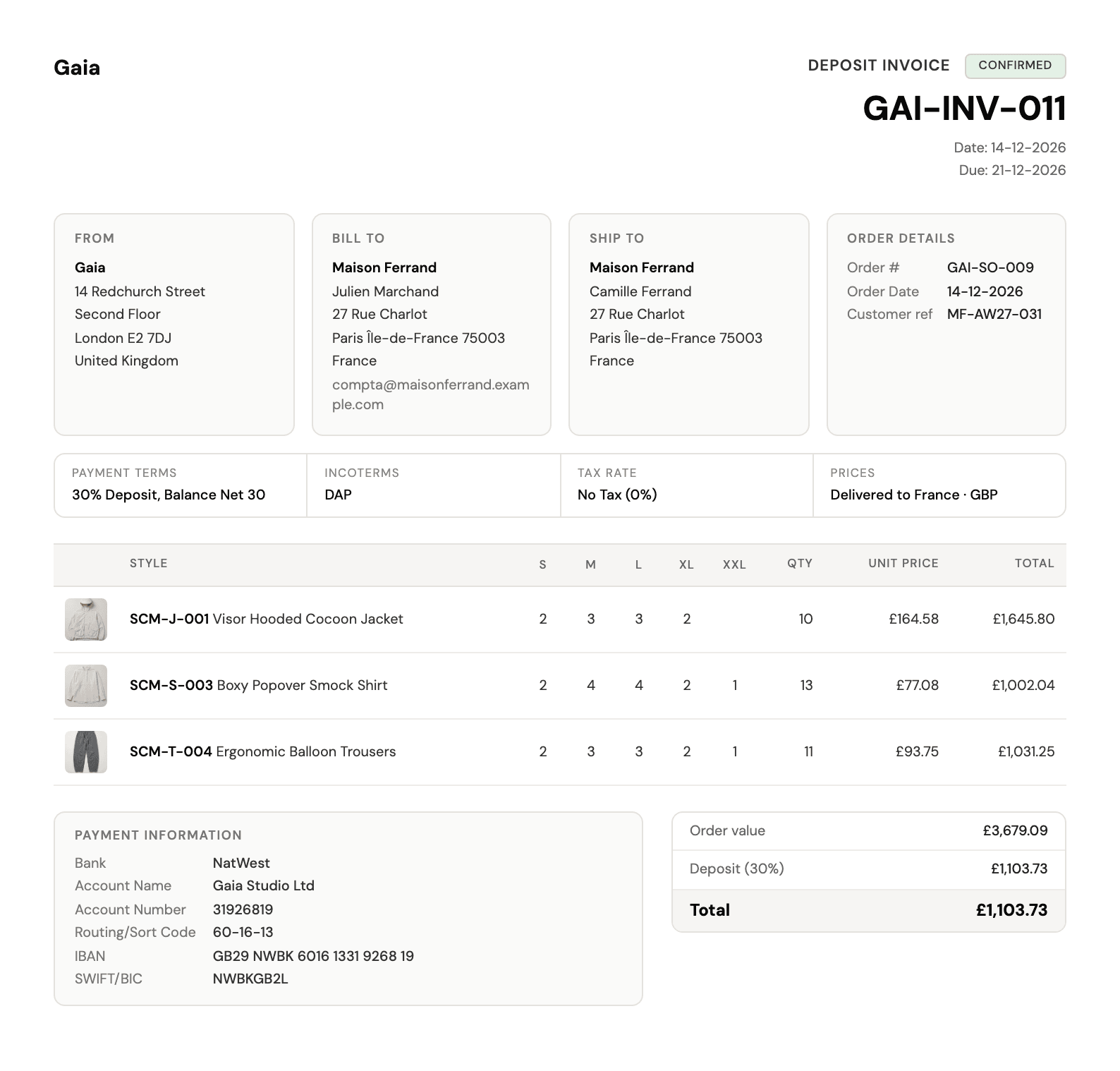
A real invoice for part of a confirmed wholesale order, sent before you make the goods. It follows the order confirmation, and a balance invoice bills the rest later, minus what's been paid.
What is a pro forma invoice?
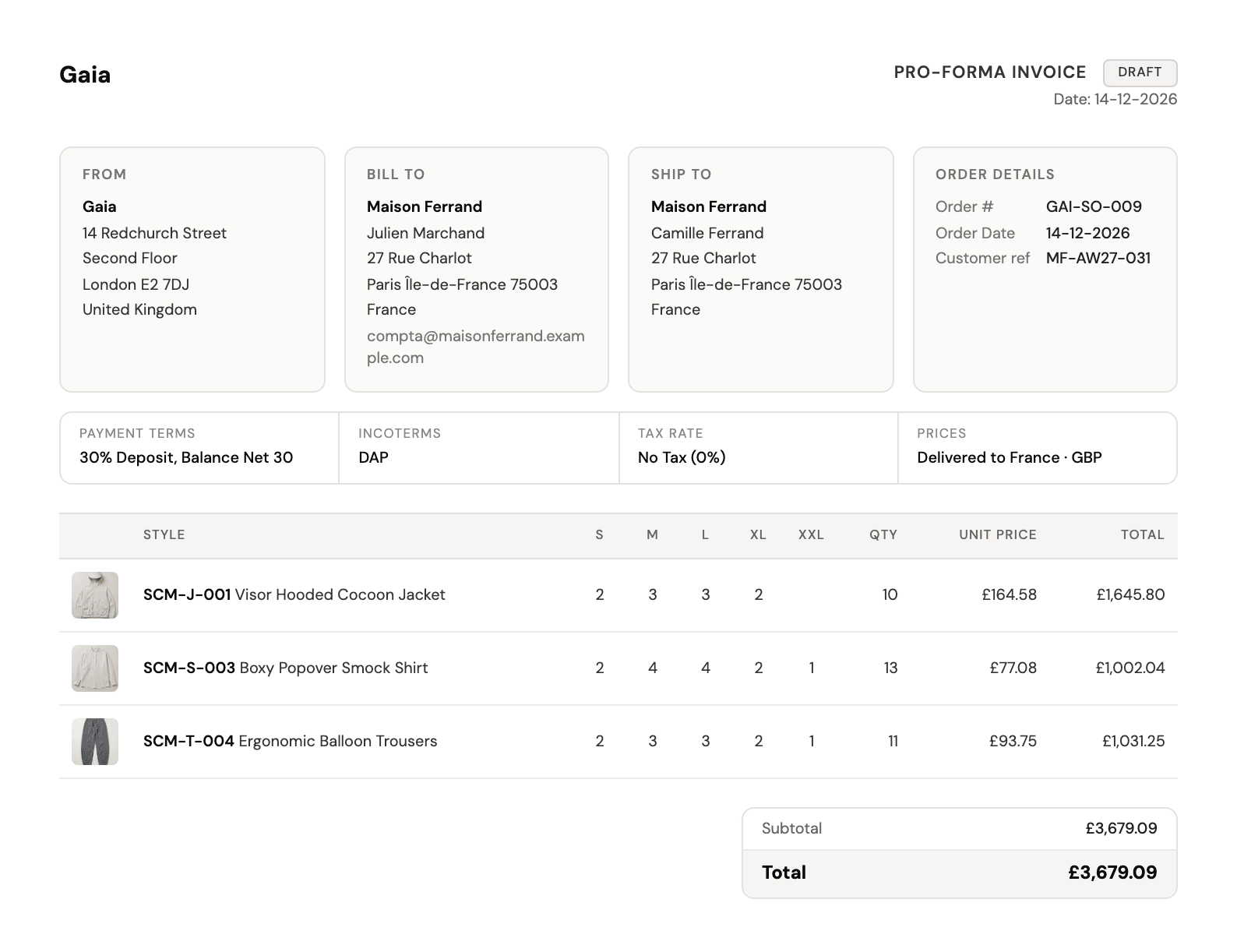
A quote in invoice format: it shows the buyer exactly what they'll be billed before the real invoice exists. It has no invoice number and doesn't create a debt.
Buyers ask for one to arrange funds, open a letter of credit or apply for an import licence (trade.gov). It usually becomes the commercial invoice when the goods ship.
In US customs, "pro forma invoice" also means a substitute invoice filed when the commercial invoice isn't available at entry (19 CFR 141.86(c)). That's a different document.
What's the difference between a pro forma, a deposit invoice and a commercial invoice?
A pro forma shows what the buyer will pay, a deposit invoice asks for part of it now, and a commercial invoice travels with the goods when they're exported. In the order you'd send them:
| Document | When you send it | What it's for | Asks for payment? | Invoice number? |
|---|---|---|---|---|
| Order confirmation | When you accept the order | Confirms the styles, sizes, quantities, prices, delivery window and terms | No | No, it has your order number |
| Pro forma invoice | Early, if the buyer needs it to arrange funds, a letter of credit or an import licence | A quote in invoice format | No, it doesn't create a debt | No |
| Deposit invoice | Right after the confirmation, before production | Bills part of the order up front | Yes, the deposit | Yes |
| Balance invoice | When your terms say: before shipping, with each shipment or on net terms | Bills the rest, minus the deposit | Yes, the balance | Yes |
| Commercial invoice | When you export; it travels with the goods | The invoice customs uses to set duty | It states the full value; payment follows your terms | Yes |
Since the pro forma becomes the commercial invoice, describe the goods the same way on both. Our guide to commercial invoices for clothing exports covers what customs needs.
When should you ask a wholesale buyer for a deposit?
On new accounts, on international orders, and on any order you'd otherwise fund alone. Always against a confirmed order: a deposit taken before the styles, quantities and prices are agreed leaves room to argue about what it paid for.
New accounts and first orders. You don't know how they pay yet.
International buyers. You're shipping across a border before you're paid in full. trade.gov calls payment before shipping the most secure method for an exporter, and a deposit gets you part of the way.
Orders you'd otherwise fund alone. If your supplier wants paying before production, the deposit puts the buyer's money in too.
Which wholesale payment terms can you offer?
Prepay. The full amount in advance. Exporters call this being paid "by proforma", because the buyer pays against the pro forma.
Deposit plus balance before shipping. A deposit on confirmation, the rest before the goods leave you.
Deposit plus balance on net terms. A deposit on confirmation, the rest a set number of days after you invoice it, such as net 30.
Net 30 or net 60. No deposit, so you've made and shipped the goods before any money arrives.
Whichever terms you choose, put them where the buyer sees them before ordering: the terms page of your line sheet, the order confirmation and, for bigger accounts, your retailer agreement.
What goes on a deposit invoice?
Enough that the buyer's accounts team can pay without asking you a question:
Invoice number and date. It's a real invoice, so it takes the next number in your sequence.
Both parties. Names and addresses, plus the buyer's accounts contact.
The order. Your order confirmation number and the buyer's PO number.
Order total, deposit percentage and amount. All three, so the sum is obvious: €6,000, 30%, €1,800 due.
A due date. A specific date, so everyone knows when it's late.
Bank details. Account name, IBAN or account number, and the SWIFT/BIC a buyer abroad needs.
How the balance will be billed. For example, "Balance of €4,200 to be invoiced before shipping".
VAT, if you're registered. See the VAT section below.
What goes on a pro forma invoice?
Trade.gov lists six things:
Seller and buyer. Names and addresses.
Unit prices and totals. Each style's quantity, unit price and line total, then the order total and currency.
The Incoterm. It decides who pays import duty: the buyer under EXW and DAP, you under DDP.
Payment terms. With the amounts, if there's a deposit.
Estimated ship date. When the goods should leave you.
Validity date. How long the prices hold, because it's a quote.
Head it "Pro forma invoice", reference the order, and don't give it a number from your invoice sequence, so it's never mistaken for a demand for payment or booked as a sale.
How do you invoice the balance?
Bill the order total minus the deposit, as one invoice or across the invoices for each shipment.
The confirmed order
Billed on confirmation
€6,000 minus €1,800
Bill it before shipping or when you ship, as your terms say. On balance-before-shipping terms, don't release the goods until it's paid. If the order ships in parts, the shipment invoices should add up to €4,200. Show the deposit on the balance invoice as its own line with its invoice number, so the buyer can follow the sum.
What about the commercial invoice?
If the goods are exported, the commercial invoice shows them at full value, not just the balance left to pay. Reference the deposit invoice alongside the pro forma or PO, and ask your freight forwarder if you're unsure how to show it. It also needs an HS code for each style, which our free HS code lookup finds.
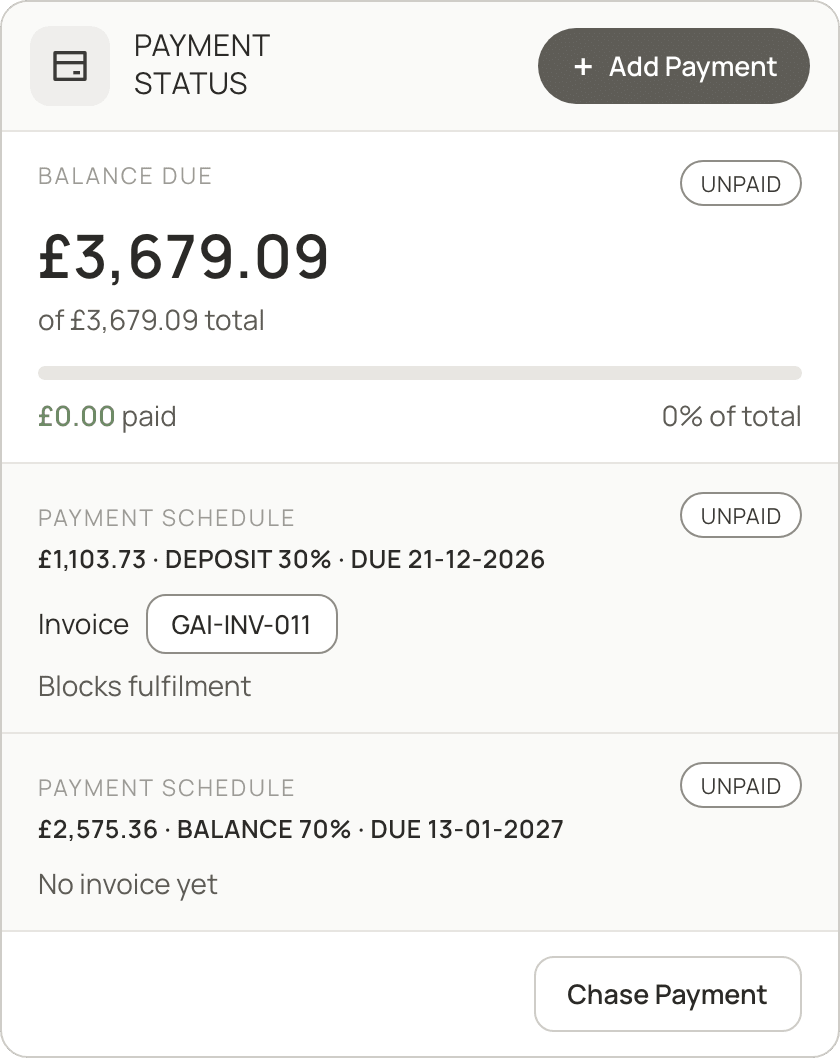
Confirming an order on deposit terms issues the order confirmation and the deposit invoice in one step, due seven days later by default, and schedules the balance as one invoice or with each shipment. Terms come as presets, such as Prepay and "50% Deposit, 50% Before Shipping", or you set your own percentage. If a buyer asks for a pro forma, you can issue one from any confirmed order.
How does VAT work on deposits in the UK?
For a UK VAT-registered brand, VAT on a deposit is normally due when you receive it, not when the goods ship: most deposits are advance payments, which create a tax point on receipt (HMRC VAT Notice 700, paragraph 14.2.3). Exports are different: exports of goods are usually zero-rated if you keep evidence of export (VAT Notice 703), so ask your accountant how that applies to a deposit taken before the goods leave.
Frequently Asked Questions
What's the difference between a deposit invoice and a pro forma invoice?
A deposit invoice is a real invoice for part of a confirmed order: it has a number and a due date, and it asks for payment. A pro forma is a quote in invoice format, with no invoice number, and it doesn't create a debt.
What's the difference between a pro forma invoice and a commercial invoice?
A pro forma is a quote sent early in the deal. A commercial invoice travels with exported goods, and customs uses it to set duty. The pro forma usually becomes the commercial invoice.
How much deposit should I ask a wholesale buyer for?
There's no fixed rule. Ask for enough to cover what you pay your supplier before the balance comes in, and state it in your terms before anyone orders.
When is VAT due on a deposit in the UK?
If you're VAT-registered, usually when you receive it, because most deposits are advance payments, which create a tax point (HMRC VAT Notice 700). Exports of goods are usually zero-rated if you keep evidence of export.
Joe's the founder of Kōbō Labs. Before this, he founded Satta, a fashion brand he scaled to sell internationally at Mr Porter, SSENSE, and Beams Japan. A decade of running his own brand (design, suppliers, production, the lot) is what Kōbō is built on.
Related Articles
Confirm the order, send the deposit invoice.
In Kōbō, confirming an order on deposit terms issues the confirmation and the deposit invoice together, and schedules the balance.