

Packing Lists, Carton Labels and Shipping Marks for a First Store Delivery
What goes on the packing list and on every carton, how both match the commercial invoice, and what changes when a big store sends a routing guide or has several distribution centres.
 Joe Lauder·Founder, Kōbō·Updated Nov 2, 2026
A packing list says what's in every carton. It names the seller, buyer, invoice number, ship date and carrier, then lists each carton's contents, weights and marks. Each carton's label carries the same marks: who it's for, the store's PO number and "carton 3 of 8". The packing list must match the commercial invoice, and if a store sends you a routing guide, its rules come first.
What is a packing list?
The document that itemises a shipment carton by carton: what's in each, what it weighs and how it's marked. It travels inside a carton or in a sleeve on the outside. Your freight forwarder uses it to work out freight costs, and on an export, customs may use it to check the cargo.
Make the full version for domestic deliveries too: it's the same work, and every carton is accounted for.
What goes on a packing list?
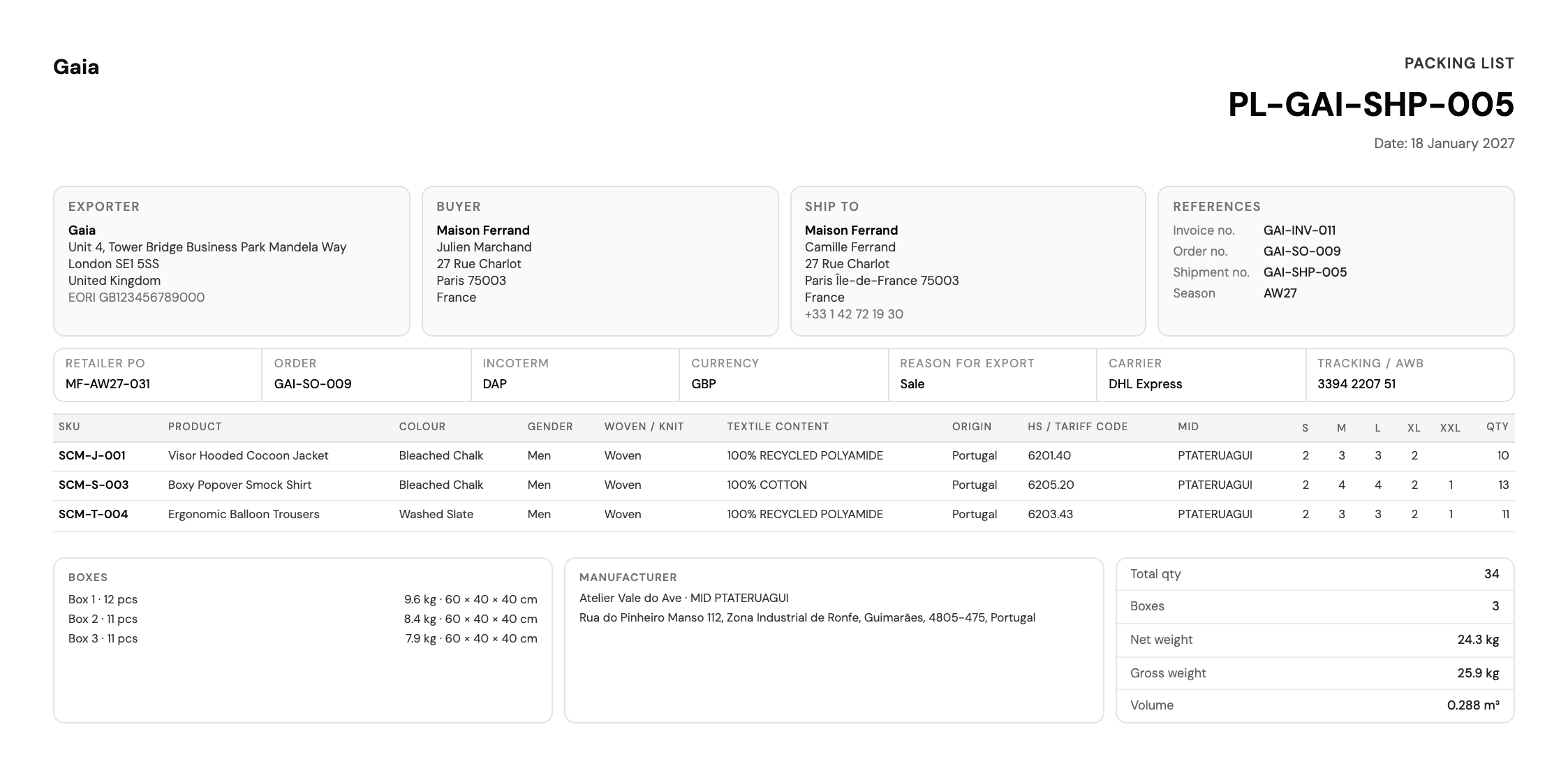
Use this as your template:
| Field | What to write |
|---|---|
| Seller | Your business name and address. |
| Buyer | The store, as it appears on the order. |
| Ship to | Where the cartons go, if that's not the buyer's address, such as a distribution centre. |
| Shipper | Whoever sends the goods, if that isn't you, such as your warehouse. |
| Invoice number | The commercial invoice for this shipment, so the two can be matched. |
| Store PO number | Also on the invoice and every carton label. |
| Shipment date | When the cartons leave you. |
| Transport | Road, air or sea, and the carrier. |
| Packages | What the goods are packed in and how many, such as "8 cartons". |
| Contents of each carton | One line per carton: style, colour, quantity per size and total pieces. |
| Net and gross weight | Per carton and in total. Net is the goods; gross includes the packing. |
| Marks | Each carton's marks exactly as on its label, such as "Carton 3 of 8". |
Describe the contents by style and colour, the way the store ordered them and the way the invoice does, not as "clothing".
What are shipping marks, and what goes on a carton label?
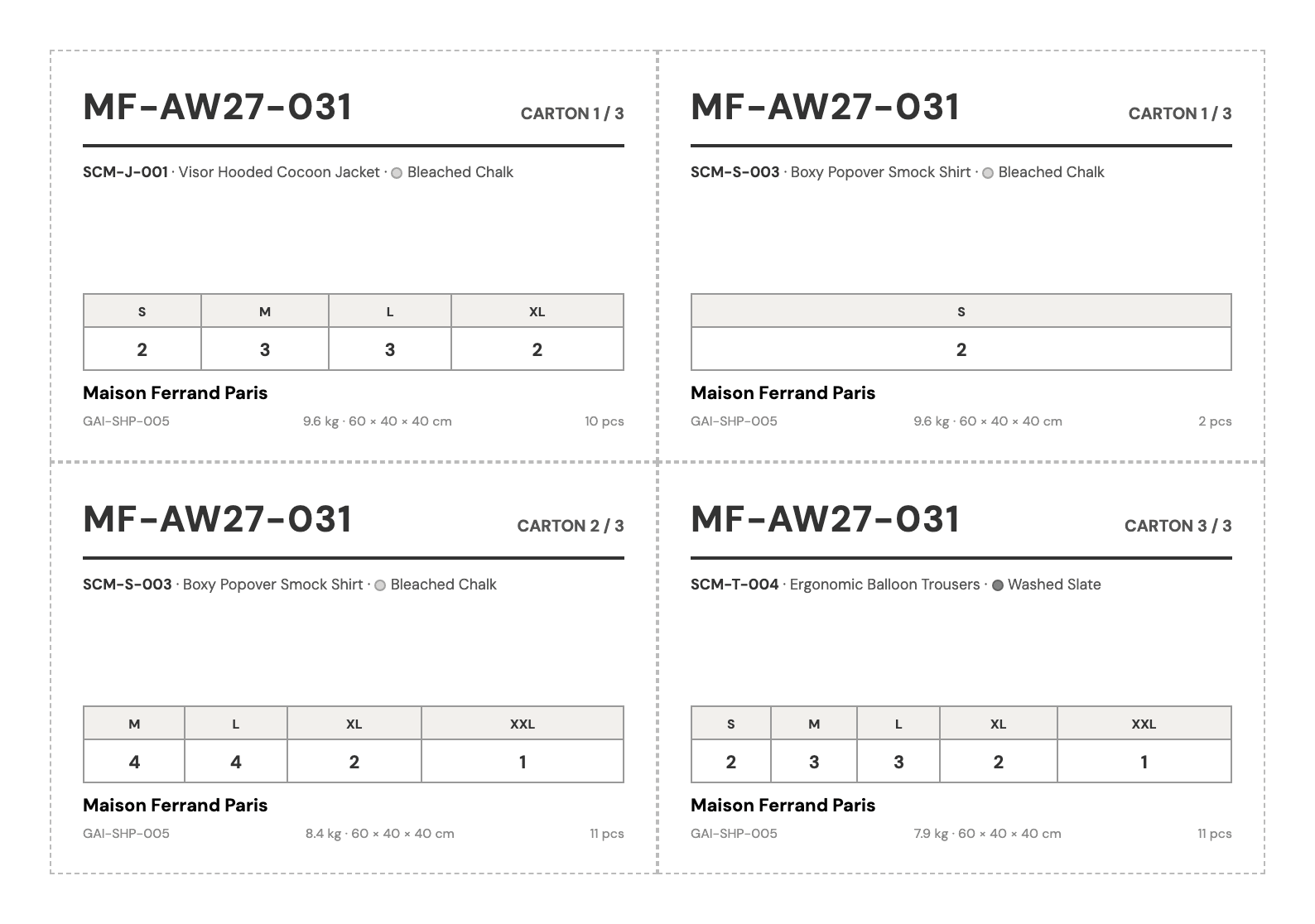
Shipping marks are the marks and numbers on the outside of each carton, and the label is where they go, with who the carton's for and what's inside. They tie each carton to its paperwork: the commercial invoice shows them (UK guidance gives "1 of 6 boxes" as an example), and the packing list lists each carton by them.
What to put on each carton label
Ship to. The receiving address. If the store receives at a distribution centre, that's the DC, not the shop.
The store's PO number. So the carton can be matched to the order.
Carton number. "Carton 3 of 8", numbered the same as on the packing list.
Contents. Style, colour, size breakdown and pieces.
Weight and dimensions. The carton's gross weight and measurements.
Country of origin, if required. The US requires it on imported goods and often on their outer containers. Check other countries with your freight forwarder.
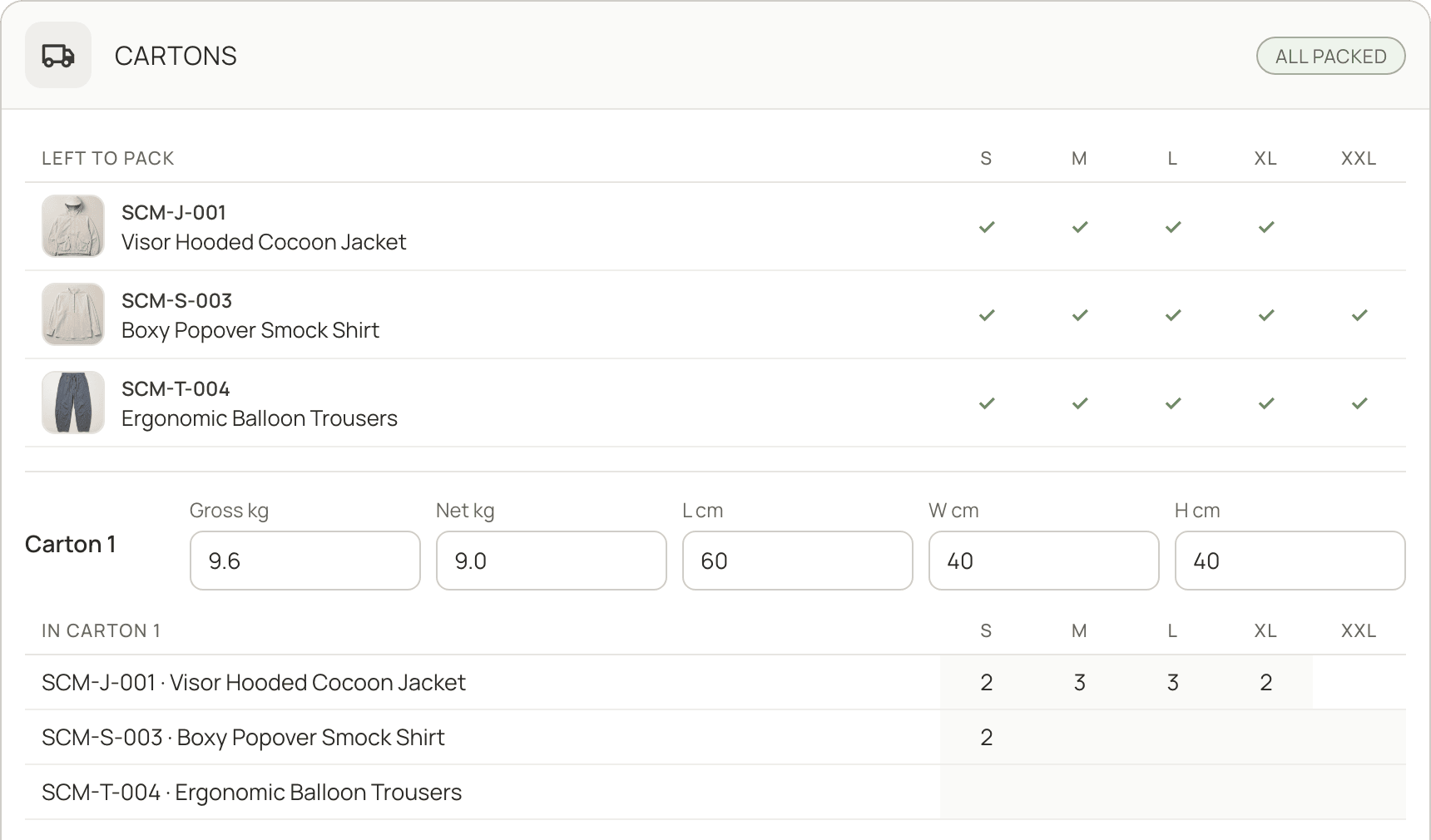
Before you seal a carton, check that the sizes add up to the piece count, and that the labels and packing list agree on the carton number, pieces and weight. Carton 1 below holds 10 jackets and 2 shirts, so it gets a label for each style, both marked 1 of 3. Together they're the 12 pieces and 9.6 kg listed as Box 1 on the packing list above.
Does the packing list have to match the commercial invoice?
Yes. Customs may check one against the other, so the number of cartons, their marks, the weights and the style names and quantities must be the same on both. The invoice adds the prices, HS codes and origin, and for the US it must also say what's in each carton (19 CFR 141.86(e)).
The simplest way to keep them matched is to make both from the same packed and weighed cartons, and to redo both if you repack anything. Our guide to commercial invoices for clothing exports covers the rest of the invoice, and the free HS code lookup finds each style's code.
What's a routing guide, and why does it matter?
A big store's own rulebook for how brands deliver to it, sometimes called a vendor compliance manual. If a store sends you one, it overrides the general practice in this guide. It usually sets the label format, carton size and weight limits, and the advance shipping notice you send before the delivery.
It matters because breaking it can cost you chargebacks: deductions the store takes from what it owes you. Ask for it when the order's confirmed, read it before you pack, and raise any rule you can't meet before the cartons leave, not after. Chargebacks are worth covering when you agree terms with the store, too.
What changes when a store has several distribution centres?
Each distribution centre becomes its own delivery, with its own cartons, labels and packing list.
Confirm the split first. Which quantities go to which DC, before you pack.
Don't mix deliveries. Goods for two DCs never share a carton or a packing list.
Number cartons per delivery. 1 of 5 to one DC and 1 of 3 to the other.
Check the routing guide. Its rules on splitting deliveries win.
Each order delivers to one of the store's saved addresses, so a store with two DCs means two orders, each packed into its own cartons with its own labels and packing list. When it ships, a shipment notice emails the store the tracking, cartons and packing list.
Frequently Asked Questions
What should a packing list template include?
The seller, buyer and shipper, the invoice number, ship date and carrier, then one line per carton with its contents (style, colour, sizes and pieces), net and gross weight and marks, plus totals for the shipment.
What's the difference between a packing list and a commercial invoice?
The commercial invoice records the sale: prices, terms, HS codes, origin and value. The packing list records the cartons: what's in each, what it weighs and how it's marked. Customs may check one against the other, so they must match.
Where do you put the packing list in a shipment?
Inside a carton, or in a protected sleeve on the outside, with a copy to your freight forwarder, who uses it to work out freight costs.
What happens if you don't follow a store's routing guide?
The store can charge you back for breaking it, as the guide sets out. Read it before you pack, and raise any rule you can't meet before the cartons leave.
Joe's the founder of Kōbō Labs. Before this, he founded Satta, a fashion brand he scaled to sell internationally at Mr Porter, SSENSE, and Beams Japan. A decade of running his own brand (design, suppliers, production, the lot) is what Kōbō is built on.
Related Articles
Commercial Invoices for Clothing Exports
What goes on a commercial invoice for clothing, line by line.
Deposit and Pro Forma Invoices for Wholesale
How deposits, balances and pro formas work on a wholesale order.
Negotiating Retailer Agreements
Terms, returns and chargebacks to agree before you sign with a store.
Pack it once. Labels and packing list follow.
Pack the shipment into cartons in Kōbō and print every carton label, plus a packing list that matches the commercial invoice.