
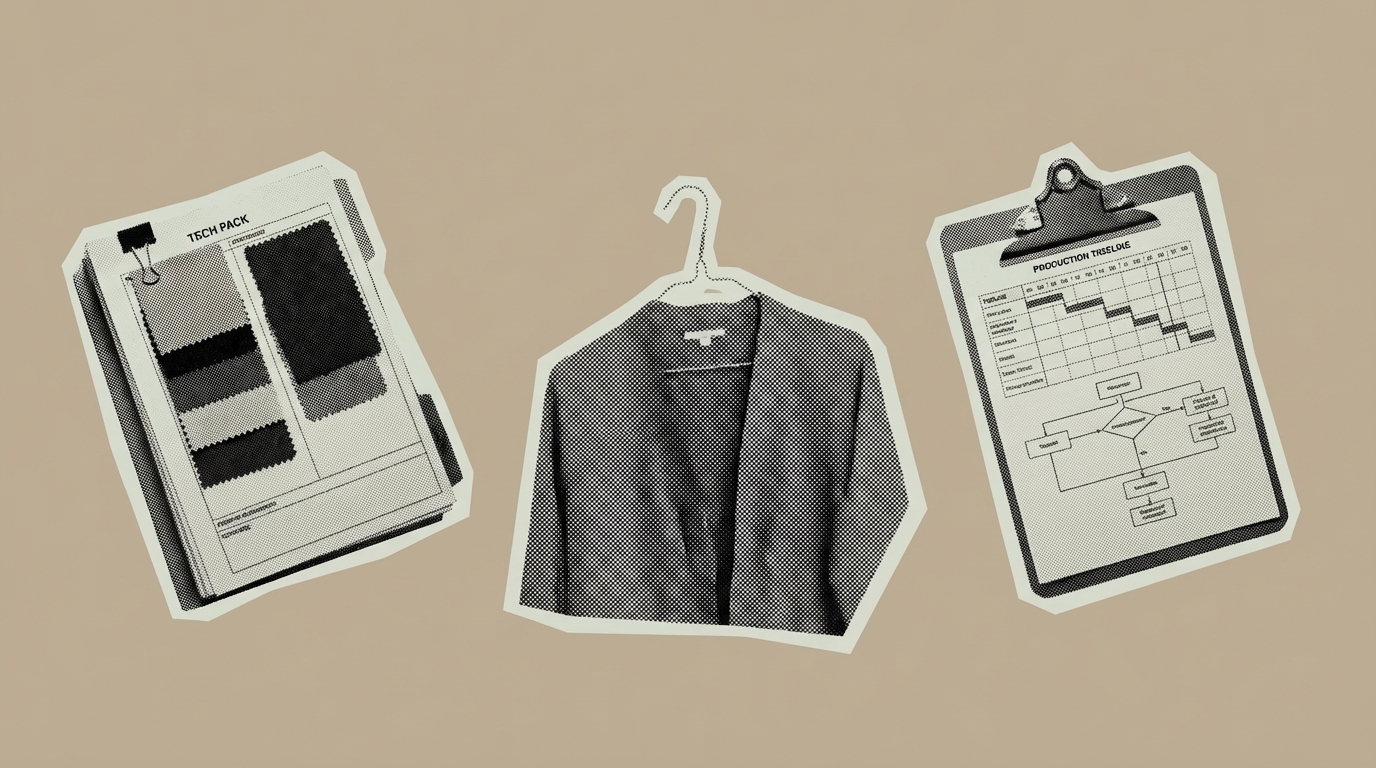
What Is Fashion PLM?
What is PLM in fashion? Product lifecycle management for fashion and apparel brands - what it is, why it matters, and when your brand is ready for it.
 Joe Lauder·Founder, Kōbō·Updated Sep 14, 2026
If you've ever lost a tech pack in an email thread, sent the wrong version to a factory, or spent an entire morning hunting for a fabric swatch reference across three different spreadsheets - you already understand the problem that fashion PLM solves. It's the single source of truth for everything your brand designs, develops, sources, and produces.
Already know what PLM is and just want a tool? Skip ahead to our roundup of the best fashion PLM software for apparel brands.
PLM, Defined
PLM stands for Product Lifecycle Management. In fashion and apparel, it's the system that manages every stage of a product from first concept to final delivery - design briefs, tech packs, bills of materials, supplier communication, sample tracking, production orders, costing, and calendar planning.
Think of it as the central nervous system of product development. Instead of data spread across Google Drive, Excel files, email threads, and WhatsApp groups, everything lives in one place: linked, version-controlled, and open to everyone who needs it.
Before PLM, teams relied on spreadsheets, and some still do. But past a handful of styles per season that breaks down: versions multiply, data gets stale, and whoever built the system becomes a single point of failure.
What Fashion PLM Actually Does
Fashion PLM covers the entire product development workflow. Here's what each module handles in practice:
Tech Pack Management - Create and manage technical specifications for every style - measurements, construction details, materials, colorways, artwork placement. Generate professional PDF tech packs to share with factories.
Bill of Materials (BOM) - Track every component that goes into a product - fabrics, trims, labels, packaging. Link components to suppliers with pricing, MOQs, and lead times. Auto-calculate landed costs.
Supplier Collaboration - Give suppliers direct access to specs, approvals, and communication through a portal. No more emailing PDFs back and forth. Track who approved what, when.
Sample Management - Track samples from initial request through each round of review to final approval. Attach photos, comments, and measurements at each stage.
Production Management - Generate purchase orders, track production status, manage deliveries, and monitor the critical path. Know exactly where every order stands.
Costing & Pricing - Calculate landed costs from BOM data. Model margins across different price points. Compare supplier pricing side by side.
Calendar & Critical Path - Plan seasons with milestone dates. Track which styles are on time, at risk, or delayed. See the full pipeline at a glance.
A well-built fashion PLM doesn't just store data - it connects every piece of the puzzle so that a change in one place automatically flows everywhere it needs to go.
Who Uses Fashion PLM?
PLM touches every role in the product development process. Each person interacts with it differently, but they all benefit from having one source of truth.
Designers - Create style records, upload sketches and artwork, define colorways, build initial tech packs. PLM replaces the design brief spreadsheet.
Product Developers - Manage BOMs, source materials, coordinate with suppliers, track sample rounds. The daily workflow hub.
Production Managers - Generate purchase orders, track factory deliveries, manage the critical path. Know what's on time and what's at risk.
Sourcing Managers - Compare supplier pricing, manage vendor relationships, track MOQs and lead times across the supply chain.
Founders & Creative Directors - Get a bird's-eye view of the entire collection - what's in development, what's approved, what's shipping. No more status meetings to find out where things stand.
Suppliers & Factories - Access specs directly through a supplier portal. Submit samples, confirm pricing, update production status - without endless email chains.
Fashion PLM vs General PLM
Not all PLM is created equal. General PLM systems like PTC Windchill, Siemens Teamcenter, and Arena PLM were built for manufacturing and engineering - think automotive parts, electronics, aerospace components. They're powerful, but they don't speak the language of fashion.
Fashion PLM understands the concepts that make apparel product development unique:
Seasons and delivery windows. Colorways and size ranges. Tech packs with measurement specs. Fabric and trim components. Supplier portals and sample approval workflows. Wholesale linesheets and buyer portals. Fashion-specific costing (CMT, fabric yield, duty rates).
Engineering change orders. CAD/CAM integration. Regulatory compliance (FDA, aerospace). Manufacturing BOMs with revision control. Multi-tier assembly structures. Typically requires 6-12 months implementation with dedicated IT.
Fashion PLM vs Spreadsheets
Spreadsheets are where every fashion brand starts. And for a solo designer doing 5-10 styles per season, they work fine. The problem is that spreadsheets don't scale - and by the time you realize they're the bottleneck, you've already lost weeks of productivity.
Version chaos - PLM has one version of truth. Spreadsheets have final_v3_REAL_FINAL_updated.xlsx.
No collaboration - PLM lets designers, developers, and suppliers work in the same system. Spreadsheets live in email attachments.
Manual updates everywhere - Change a fabric in PLM, it updates the BOM, costing, and tech pack. In spreadsheets, you update 15 files manually.
Zero visibility - PLM shows the full pipeline at a glance. With spreadsheets, you need a status meeting just to find out where things stand.
Knowledge loss - When a team member leaves, PLM retains everything. With spreadsheets, their filing system walks out the door with them.
Fashion PLM vs ERP
PLM and ERP are often confused, but they serve different purposes. PLM manages what you're making - the product development process. ERP manages how you run the business - financials, HR, order processing, warehouse management.
Tech packs, BOMs, supplier collaboration, sample management, production tracking, costing, and calendar planning. Used by designers, product developers, production managers, and sourcing teams.
Accounting, invoicing, HR/payroll, warehouse management, order processing, and manufacturing scheduling. Used by finance, operations, and warehouse teams. Examples: SAP, Oracle NetSuite, Microsoft Dynamics.
When Your Brand Is Ready
Not every brand needs PLM right now. But if you recognize three or more of these signals, you've outgrown your current setup:
How to Get Started
Modern cloud PLM is designed for self-service onboarding. No 6-month implementation projects. No expensive consultants. No IT department required. If you're weighing up options, start with our comparison of the best fashion PLM software for small and mid-size brands.
With a platform like Kōbō, the typical path looks like this:
Week 1 - Import existing styles via CSV. Set up your component library and supplier contacts. Invite your team.
Week 2 - Start building new styles in the system. Invite suppliers to the portal. Run parallel with your spreadsheets if needed.
Week 3+ - Phase out spreadsheets for active development. Use PLM as the single source of truth for everything in progress.
Frequently Asked Questions
What does PLM stand for in fashion?
PLM stands for Product Lifecycle Management. In fashion, it refers to the software and processes used to manage a product from initial concept through design, development, sourcing, sampling, production, and delivery. It's the central system that replaces spreadsheets, email chains, and disconnected tools.
How does fashion PLM differ from general PLM?
Fashion PLM is built specifically for the fashion and apparel industry. It understands seasons, colorways, size ranges, tech packs, bill of materials with fabric and trim components, supplier workflows, and sample approval processes. General PLM systems (like Windchill or Teamcenter) are designed for manufacturing and engineering - they don't speak the language of fashion.
Do small brands need PLM?
If you're managing more than 20 styles per season, working with multiple suppliers, or have more than 2-3 people touching product data, yes. The breaking point usually hits when you spend more time managing spreadsheets than designing products. Modern cloud PLM like Kōbō scales with you - self-serve setup for your first organised collection, and the depth to run hundreds of styles a season across multiple suppliers. It's the modern alternative to both spreadsheets and legacy enterprise PLM, live in weeks not quarters.
How much does fashion PLM cost?
It ranges dramatically. Legacy enterprise PLM (Centric, Lectra) can cost $50,000-$250,000+ per year with 6-18 month implementations. Modern cloud PLM like Kōbō starts at $140/user/month with no setup fees and monthly billing - enterprise-grade capability without the enterprise price tag or the multi-quarter rollout. Basic tools (Techpacker) start around $49/user/month but only cover tech packs.
How do you choose a fashion PLM?
Start from the workflow you run today, not a feature list. Map where product data lives right now (tech packs, BOMs, sample rounds, supplier emails, purchase orders) and look for a platform that covers those steps without an enterprise rollout. Modern cloud PLM such as Kōbō goes live in one to two weeks and includes supplier seats; legacy suites such as Centric take six to eighteen months and an IT team. If you only ever need tech packs, a lightweight tool such as Techpacker may be enough. Our fashion PLM buyer's guide, updated September 2026, compares ten platforms by brand stage, budget and feature needs.
Joe's the founder of Kōbō Labs. Before this, he founded Satta, a fashion brand he scaled to sell internationally at Mr Porter, SSENSE, and Beams Japan. A decade of running his own brand - design, suppliers, production, the lot - is what Kōbō is built on.
Related Articles
Ready to see fashion PLM in action?
See how Kōbō replaces spreadsheets, email chains, and disconnected tools with one design-to-delivery platform.
Start Free Trial