
Commercial Invoices for Clothing: What Goes on One When You Export
Shipping your first wholesale order abroad? Here's what the invoice needs, how to describe garments so customs knows what's in the box, and what the US asks for on top.
 Joe Lauder·Founder, Kōbō·Updated Nov 2, 2026
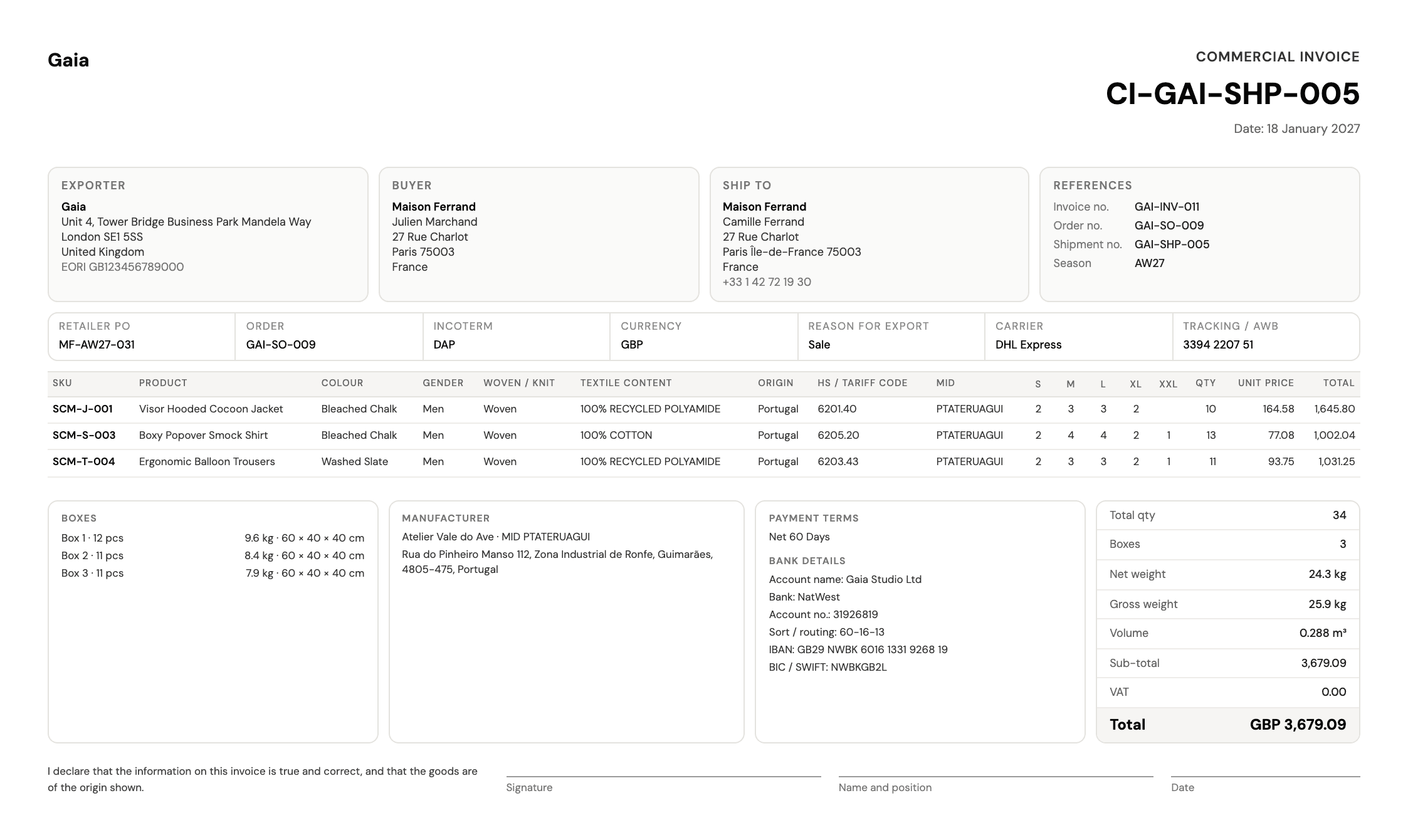
A commercial invoice tells customs what's in the shipment, where it was made and what it's worth. For clothing, what matters most is a specific description of each garment (“women's knitted T-shirt, 100% cotton”, not “clothing”), its HS code and country of origin, and the real selling price, with freight and insurance on their own lines. For the US, add fibre content by weight and your supplier's MID code.
What is a commercial invoice?
It's the invoice for goods crossing a border, and it travels with them. Customs reads it to see who's selling to whom, what's in the cartons and what it's worth, and sets the duty mainly from the HS code and country of origin.
On a wholesale order, it's the real invoice you issue when the goods ship. If you sent the store a pro forma when they ordered, the pro forma usually becomes the commercial invoice. Keep a copy: UK guidance says you must keep your customs paperwork.
What has to be on a commercial invoice for clothing?
This checklist combines UK export guidance (gov.uk) with US import rules (19 CFR 141.86). Use it as your template.
| Field | What to write | Why customs needs it |
|---|---|---|
| Invoice number and date | Your own number and the issue date. | The packing list quotes it, which ties the paperwork together. |
| Seller (exporter) | Your company name, address and EORI number (UK ones start with GB). | You can't move goods out of Great Britain without a GB EORI. EU businesses use an EU one. |
| Buyer, and consignee if different | The store's legal name and address, plus the delivery address if it's a warehouse. | Customs wants to know who bought the goods and who receives them. |
| Related paperwork | The store's PO number and your pro forma or order number. | So the invoice can be matched to the order behind it. |
| Description of goods | What it is, knitted or woven, and the fibre: “Women's knitted T-shirt, 100% cotton”, plus your style code so it matches the packing list. | US customs guidance says “clothing” isn't an adequate description. |
| HS code | The commodity code for each line: chapter 61 if knitted, 62 if woven. | With origin, it sets the duty. A wrong code can hold the shipment or change what the buyer pays. |
| Country of origin | Where each garment was made, line by line. | With the HS code, it sets the duty rate. |
| Quantity | Pieces per line. | Customs may check it against the packing list. |
| Unit price, totals and currency | Your selling price per piece, the line totals, the invoice total and the currency. | Customs works out the value of the goods, and so the duty, from it. |
| Discounts and other charges | Any discount, then freight, insurance and packing as separate lines. | US rules ask for every charge itemised by name and amount. |
| Incoterm and payment terms | The Incoterm with its named place (DAP Paris), and how the store pays (net 30). | The Incoterm decides who pays the import duty and taxes. |
| Weights | Gross (with packaging) and net (goods only). | Part of the UK's minimum data, and checked against the packing list. |
| Packages and marks | How many cartons, and their marks, such as “1 of 6”. | Ties each carton to the paperwork. |
| Transport | Mode and route. For the US, the port of entry. | UK and US guidance both ask for it. |
| Fibre content and manufacturer (US) | Fibre percentages by weight, shell and lining separately, and your supplier's MID or full name and address. | US rules require the fibre content on the invoice, and the importer's broker needs the MID for the entry. |
Other countries can ask for more. Before a first shipment to a new country, check with the buyer or your freight forwarder.
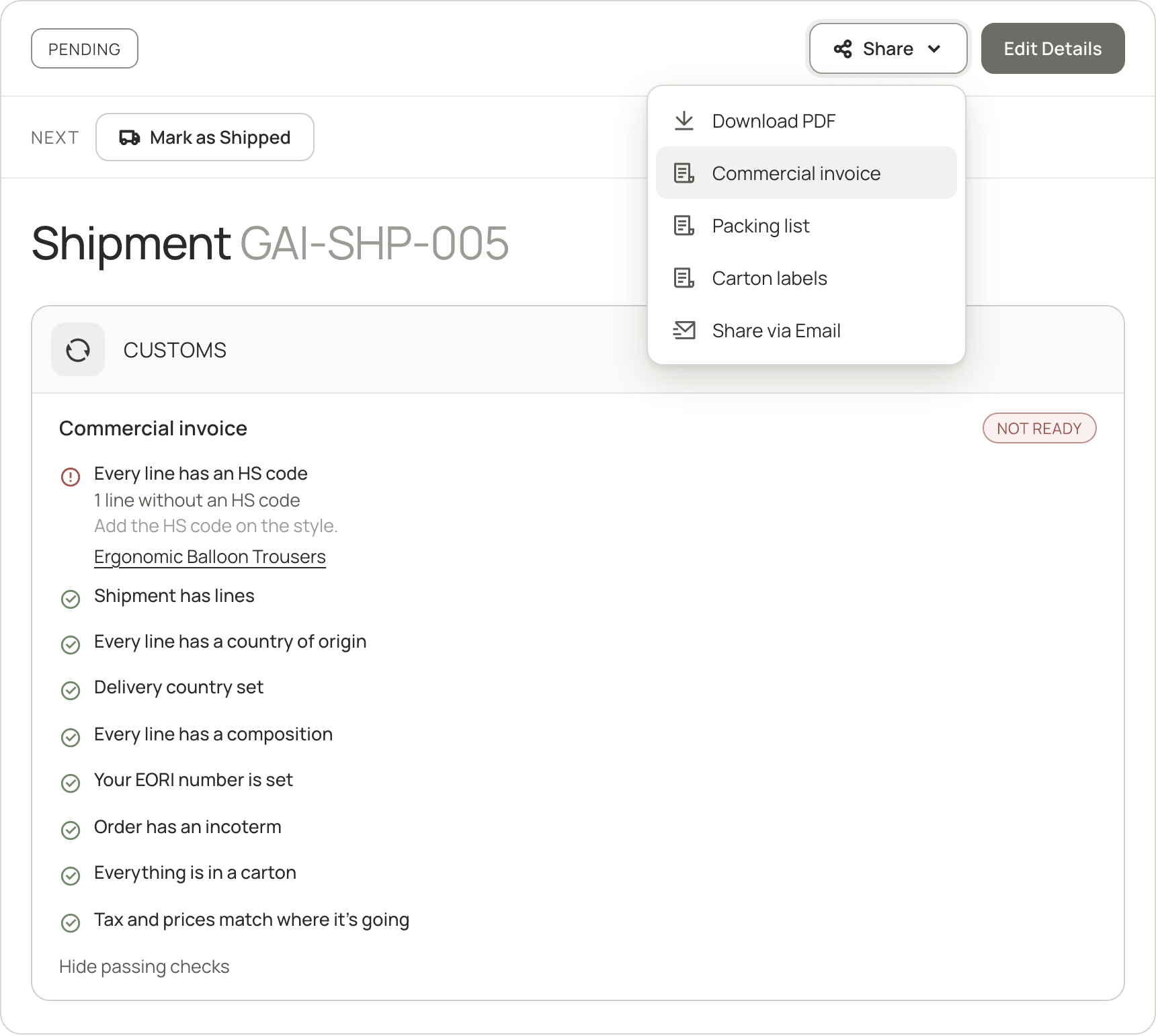
Kōbō makes the commercial invoice from the sales shipment. You set the HS code, origin, MID and composition once on the style, and every invoice line takes them from there. It won't generate the invoice while a line is missing its HS code or origin.
How should you describe garments so customs accepts them?
Specifically enough that someone who's never seen it could picture it: what it is and who it's for, knitted or woven, and the fibre. “Women's knitted T-shirt, 100% cotton” works. “Clothing” doesn't, and US customs guidance says so.
Knitted or woven decides the HS chapter: 61 for knits, 62 for wovens. The first six digits are shared by more than 200 countries; the UK and EU add digits (8 for exports, 10 for imports), and the US uses its own 10-digit HTS code. Find yours by garment, fibre and construction in our free HS code lookup for clothing.
A worked example: one invoice line
A T-shirt made in Portugal, with made-up numbers:

What extra do US customs need for clothing?
Two things: fibre content by weight, and who actually made the goods. US rules for textile clothing (19 CFR 141.89) ask for:
Fibre content by weight for the whole garment, for example 100% cotton.
Shell and lining separately: one breakdown for the outer shell (not counting cuffs, waistbands, collars and trims) and one for the lining.
Woven garments: whether the fabric is yarn dyed, and whether the warp or filling has two or more colours.
All-white T-shirts and singlets: whether there are pockets, trim or embroidery.
Scarves: the exact length and width.
The manufacturer's MID code
US entries of clothing must name the manufacturer with a Manufacturer Identification Code, or MID (19 CFR 102.23). It's built from the name and address of whoever made the goods, which is your supplier, not your brand. It's up to 15 characters and starts with the country of origin's ISO code, so a garment made in Portugal has a MID starting with PT.
The importer's customs broker files it (the store's, unless you ship DDP), and CBP may reject an entry without a valid one, so put your supplier's MID, or at least their full name and address, on the invoice.
Who pays the duty, and what Incoterm goes on the invoice?
Whoever the Incoterm says, so agree it with the store and put it on the invoice with its named place. Three common ones:
The buyer collects from you and handles everything after, including import duty and taxes.
You deliver to a named place. The buyer pays the import duty and taxes.
You deliver and you pay the import duty and taxes.
Settle it when you agree terms with the store, not when the boxes are packed. If you agree to DDP, the duty is your cost, so build it into your price; our garment costing guide covers landed cost.
How does the commercial invoice fit with the pro forma and the packing list?
Three documents for one order. The last two travel with the goods and must agree:
Pro forma (before shipping). A quote in invoice format, which the buyer may need to arrange funds or open a letter of credit.
Commercial invoice (when the goods ship). The real invoice. Prices, Incoterm and terms carry over from the pro forma.
Packing list (with the goods). What's in each carton, with weights and marks. Customs may check it against the invoice.
More in our guides to deposit and pro forma invoices and packing lists and shipping marks. One US trap: there, “pro forma invoice” also means a substitute invoice filed when the commercial invoice isn't available at entry, which isn't the quote you sent the store.
What mistakes hold up a shipment?
Most come down to an invoice that's vague or doesn't match the rest of the paperwork. Check these before the cartons leave:
“Clothing” as the description. Name the garment, knitted or woven, and the fibre.
A missing HS code or origin. Customs can't set the duty without them.
A value that isn't the real price. Show a discount as a discount, and freight and insurance on their own lines, not folded into the unit price.
Totals that don't match the packing list. Pieces, cartons and weights have to agree.
No EORI number. UK exporters need one starting with GB.
For the US, no fibre breakdown or MID. CBP may reject an entry without a valid MID.
Frequently Asked Questions
What goes on a commercial invoice for clothing?
The seller (with an EORI number if you're in the UK) and buyer, an invoice number and date, a plain description of each garment with its HS code and country of origin, quantities, prices and the currency, the Incoterm, weights, package marks, and freight and insurance listed separately.
Do I need an HS code on a commercial invoice?
Yes. UK guidance puts it in the minimum data, and customs uses it with the country of origin to set duty. Clothing is chapter 61 if it's knitted and chapter 62 if it's woven.
What is a MID code on a commercial invoice?
A Manufacturer Identification Code, which US customs needs on clothing and textile entries. It identifies the company that made the goods (your supplier, not your brand), is up to 15 characters long and starts with the country of origin's ISO code.
Who pays import duty on a wholesale order shipped abroad?
Whoever the Incoterm says. Under EXW and DAP the buyer pays the import duty and taxes. Under DDP you do, so price it in.
Is a pro forma invoice the same as a commercial invoice?
No. A pro forma is a quote sent before shipping, so the buyer can arrange funds or a letter of credit. The commercial invoice is the real invoice that travels with the goods, and the pro forma usually becomes it.
Joe's the founder of Kōbō Labs. Before this, he founded Satta, a fashion brand he scaled to sell internationally at Mr Porter, SSENSE, and Beams Japan. A decade of running his own brand (design, suppliers, production, the lot) is what Kōbō is built on.
Related Articles
Deposit and Pro Forma Invoices
What a deposit invoice and a pro forma are, and when to send each on a wholesale order.
Packing Lists and Shipping Marks
What goes on an export packing list and on the cartons themselves.
HS Codes for Clothing
Free lookup: find the HS code for a garment by fibre and construction.
Make the commercial invoice from the order.
Set the HS code, origin, MID and composition once on each style, and Kōbō carries them onto every commercial invoice line when the order ships.