
Cut and Sew Manufacturing: What It Means and How It Works
How cut and sew differs from CMT, full package and private label, what the process actually involves, the MOQs and costs to expect, and how to brief a factory so it quotes you properly.
 Joe Lauder·Founder, Kōbō·Updated Jul 29, 2026
Cut and sew means a factory cuts fabric from your patterns and sews it into a finished garment built to your specification, rather than printing on a blank or putting your label into a style from someone else's catalogue. It's how every original garment gets made, and it's the point where a clothing brand stops buying products and starts making them. I ran cut and sew production for a decade at Satta, the brand I founded before Kōbō, selling into Mr Porter, SSENSE and Beams Japan. This guide is the version of the process I wish someone had written down for me: the models, the steps, the minimums, what actually moves the price, and how to brief a factory so it takes you seriously.
What Cut and Sew Actually Means
The name is literal. Fabric is cut using your patterns, and the cut pieces are sewn into a garment. Everything the finished piece is made of comes from your specification: the cloth, the fit, the seam types, the trims, the labels, the way it's folded in the bag. Nothing is chosen from a supplier's stock range.
That distinction matters more than it sounds. A brand doing cut and sew owns its patterns and its fit. A brand printing on blanks owns its graphics and nothing else, which means anyone with the same graphic idea and the same blank supplier is selling a comparable product at a lower price a season later. Owning the pattern is what makes a garment difficult to copy quickly, and it's what lets you improve the same style year after year instead of restarting from a catalogue every season.
In practice, cut and sew is a category rather than a single contract. The same factory might quote you on a labour-only basis where you supply the cloth, or on a finished price where it buys everything. Both are cut and sew. What changes is who carries the material risk, which is the subject of the next section.
Cut and Sew vs CMT, Full Package and Private Label
Most confusion in sourcing conversations comes from people using four different words for overlapping things. Here is the honest version of how the models line up, and what each one asks of you.
| Model | Who buys the fabric | Design control | Typical MOQ | Best for |
|---|---|---|---|---|
| Cut and sew | You or the factory, depending on the deal | Full: your patterns, your fit, your construction | 100-300 per style per colourway | Brands with a point of view on fit and fabric |
| CMT (cut, make, trim) | You buy and ship the fabric and trims | Full, and you carry the material risk | 50-200, workshop dependent | Brands that source their own cloth or use local mills |
| FPP (full production package) | Factory sources everything to your spec | Full on design, shared on materials | 300+ is common | Scaling brands consolidating suppliers |
| Private label | Factory, from its own stock | Pick a block from a catalogue, add your label | 50-300 | Fast range building and basics |
| Blanks and decoration | Bought finished, then printed | Graphics only | 1-50 | Merch and testing demand |
CMT: you supply the cloth
CMT stands for cut, make, trim. You buy the fabric and trims, ship them to the factory, and pay a labour price per garment. It's the cheapest way to buy sewing on paper, and it gives you complete control over the cloth, which matters if the fabric is the reason your product exists. The catch is that you're now a materials business as well as a clothing brand. You carry the mill minimums, the lead times, the shipping, the customs, and the risk that a fault in the roll turns into an argument about who pays for the cut panels.
Full production package: the factory sources everything
In a full production package, sometimes called FPP or full package production, the factory buys the fabric and trims against your specification and quotes one finished price per garment. You give up some visibility on materials and pay for the factory's working capital, but you get one invoice, one lead time and one party responsible when something is wrong. For most growing brands this is the sane default, especially when the factory is buying from mills you could not reach at your volume anyway.
Private label: the fast route with a ceiling
Private label means choosing an existing style from a supplier's catalogue and putting your label in it, sometimes with a fabric or colour change. It's quick, the minimums are low, and it's a perfectly reasonable way to fill out a range or test a category. The ceiling is that you don't own the fit or the construction, so the same garment is available to anyone else who walks through the same door.
Minimums differ across all four models and they move with fabric, season and how busy the factory is. Our MOQ guide covers how minimums get set and what actually brings them down.
The Cut and Sew Process, Step by Step
A cut and sew order is a sequence of approvals, not a single transaction. Each step exists to catch a mistake before it gets expensive, and skipping one almost always means paying for it later in rework, delay or a shipment you can't sell at full price.
Tech pack and pattern - Flats, a graded measurement chart with tolerances, a bill of materials and construction notes. The pattern is either yours or cut by the factory from your spec. This is the contract.
Proto sample - The first physical read on the idea, usually in whatever fabric is to hand. You're checking proportion and construction, not colour.
Fit sessions - Fit on a live model or a stand, note the changes, reissue the measurement chart. Two or three rounds is normal for a new block, one for a carryover.
Pre-production sample - Correct fabric, correct trims, correct labels. Sign it, date it, keep a sealed copy. Everything in bulk gets judged against this.
Grading and marker - The approved pattern is graded across your size range and nested into a marker. Marker efficiency decides how much fabric you pay for per garment.
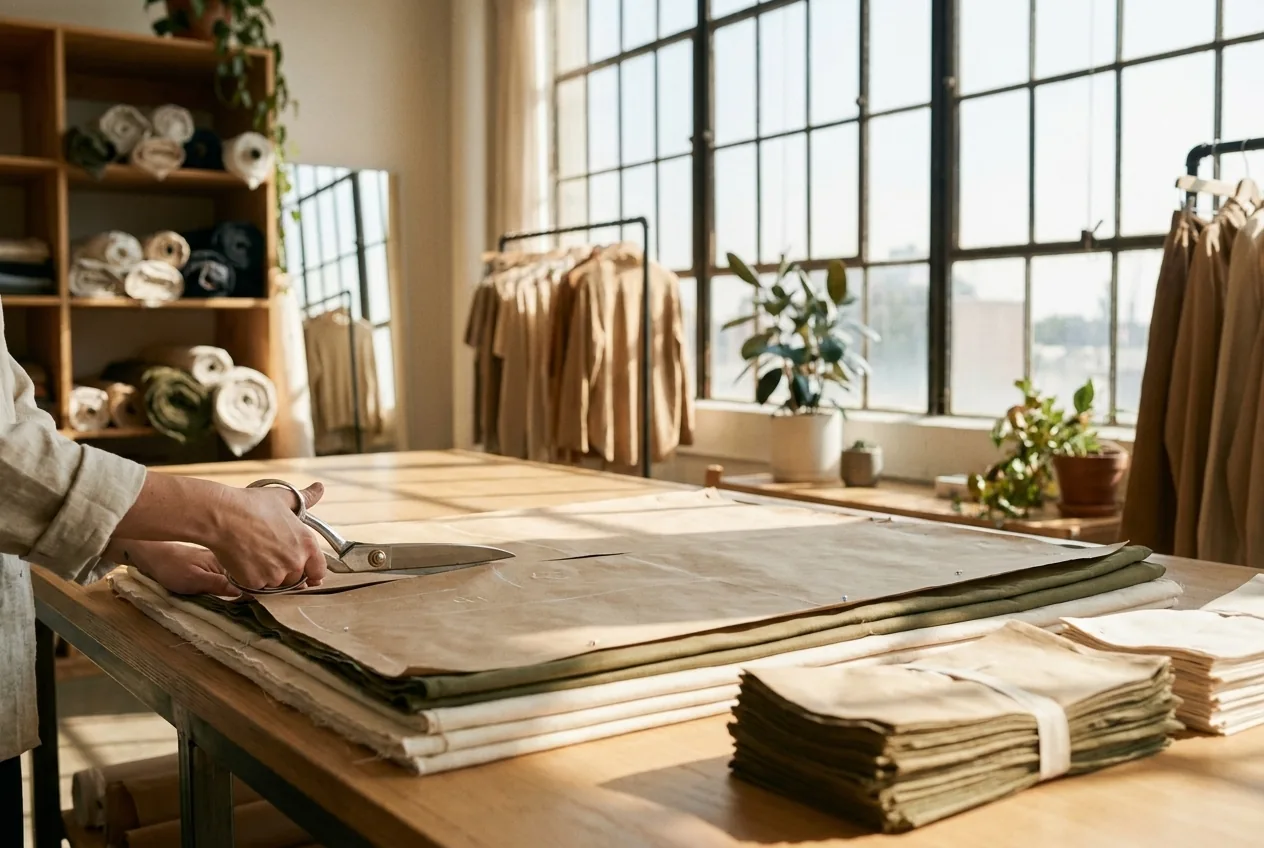
Spreading and cutting - Fabric is laid in plies, the marker goes on top, and the stack is cut. Cut pieces are ticketed and bundled by size and colourway so nothing gets mixed on the line.
Sewing - Bundles move through the line operation by operation. The number of standard minutes a garment takes is the single biggest driver of your make price.
Finishing - Trimming, pressing, labelling, hangtags, folding and polybagging to your packing spec.
Quality control - Inline checks during production and a final inspection against your sealed sample and an agreed AQL level, then packing and shipping.
Two of those steps do most of the damage when they go wrong. The first is the pre-production sample: if it's not sealed and dated, you have no agreed standard to inspect against, and every quality conversation becomes an opinion. The second is grading. A pattern graded badly fits beautifully in a sample size and falls apart at the ends of the range, which is where your returns come from.
Typical Cut and Sew MOQs
Minimums in cut and sew are quoted per style, per colourway. That's the number people miss when they plan a first order. A 200-unit minimum across three colours is a 600-unit commitment, not a 200-unit one.
As a working range, mid-sized factories commonly ask for 100 to 300 units per style per colourway. Small workshops and sample rooms will often take 50 or fewer at a noticeably higher unit price, which is a fair trade when you're proving a style. Larger overseas factories geared to volume tend to start at 300 and go up, because their economics depend on keeping a line running on one style for days rather than hours.
The number that actually binds you is usually not the sewing factory's. It's the mill's. A fabric development or a custom dye lot carries its own minimum measured in hundreds of metres, and that sits upstream of everything else. This is why so many first orders quietly become bigger than planned: the factory said 150, the fabric said 800 metres, and 800 metres makes 400 garments.
What Drives a Cut and Sew Price
There is no going rate for cut and sew, and anyone who quotes you one without seeing a spec is guessing. The price is assembled from a handful of inputs, and knowing which ones move gives you somewhere useful to negotiate rather than just asking for a discount.
| Cost driver | Why it moves the price | Where the lever is |
|---|---|---|
| Fabric | Usually the largest line on the cost sheet, and it's priced per metre, not per garment | Reduce consumption with a tighter marker, or use a mill stock quality instead of a custom development |
| Standard minutes | More operations, more topstitching, more panels means more line time | Simplify the construction on version one, add detail once the style has proved itself |
| Trims and labels | Zips, drawcords, woven labels and hangtags each carry their own minimums | Standardise trims across the range so you buy one zip in volume, not five in dribs |
| Wastage | Fabric loss in the lay, plus a percentage for shading, faults and cutting | Ask what wastage percentage is baked into the quote and how the marker efficiency was calculated |
| Order quantity | Cutting, marker making and line set-up are fixed costs spread across the run | Consolidate colourways into fewer styles to reach the price break |
| Sampling | Proto, fit and pre-production samples are charged at development rates | Fewer, better briefed rounds. Most sample rounds are caused by an ambiguous spec, not a bad factory |
Fabric is normally the largest single line, and it's bought per metre, so the way your pattern nests into the marker changes your cost per garment before a single stitch is sewn. A tighter marker on a high-volume style is worth more than any haggling over the make price. Ask for the consumption figure in the quote and check it against the garment: if it looks generous, it usually is, and a pattern adjustment can pay for itself across a run.
Labour is priced in standard minutes. A factory knows roughly how many minutes a garment takes on its line, and multiplies by its minute rate. That's why a second row of topstitching or a bound seam that looks trivial on a drawing can move the price meaningfully, and why simplifying the first version of a style is the fastest way to make the numbers work. Add a development charge for each sample round on top, and expect the first production run to carry the pattern, grading and marker costs that the reorder will not.
Whatever the factory quotes, that number isn't your landed cost. Freight, duty, inspection and the samples you paid for along the way all belong in the calculation before you set a wholesale price. Our garment costing guide walks through building the full sheet.
The cheapest quote in the folder is usually the one that read your tech pack least carefully. Price the factory that asked you the most questions.
How to Brief and Evaluate a Factory
Factories triage enquiries. They're choosing customers as much as you're choosing them, and the fastest way to be filtered out is to send a mood board and ask for a price. The fastest way to be taken seriously is to send a complete pack that shows you know what you're asking for.
What to send with a first enquiry
The tech pack - Flats, graded measurements with tolerances, bill of materials, construction notes, labelling and packing spec.
Quantities and colourways - Per style, per colourway, with your realistic first order and what a reorder would look like.
Target price and target delivery - Being honest about both saves everyone a round. A factory will tell you quickly if the two are incompatible.
A reference garment if you've one - Nothing communicates a construction faster than a physical example with your notes pinned to it.
Who you are - Two lines on the brand, where you sell and what you've produced before. It answers the risk question they're already asking.
Questions worth asking before you commit
Pay particular attention to the first question. Every factory can technically cut most things, but capability and habit are different. A workshop that sews jersey every day will make a better t-shirt than one that mostly does tailoring, even if the tailoring shop is objectively more skilled. Match the factory to the product, not to the compliment.
Vetting properly also means the unglamorous parts: references from brands your size, a real conversation about payment terms, and clarity on who pays for rework when measurements land out of tolerance. Our guide on finding the right manufacturer covers the sourcing and due diligence process in full.
When to Move from Private Label to Cut and Sew
Nobody should start with a full cut and sew range. Starting with private label or blanks to find out what your customer actually buys is sensible, and it costs a fraction of getting it wrong at the pattern stage. The question is when to make the move, and the honest answer is when the constraints of the catalogue start showing up in your numbers.
Fit is your most common complaint - A catalogue block is built for an average body, not your customer. Owning the pattern is the only real fix.
You keep asking for changes the supplier won't make - Once you're asking for a different collar, a different length and a different fabric weight, you're already paying for cut and sew without the control.
Your bestseller repeats reliably - A style that reorders is the safest first cut and sew project, because the demand risk is already answered.
You want a margin story that survives a wholesale conversation - Buyers price originality. A garment that exists in three other brands' ranges gets discounted like one.
Your fabric is the point - If the cloth is what makes the product, you need to choose the mill, and private label won't let you.
Low minimums, fast to market, low upfront cost. No pattern ownership, limited fit control, easily matched by competitors, thinner margin defence.
Full control of fit, fabric and construction. Higher minimums, longer development, real upfront cost in patterns and sampling. Compounds: every season improves the same block.
The practical way to make the switch is one style, not one range. Take the product that already reorders, develop it properly as cut and sew, and run it alongside your existing supply. You learn the whole process on a garment where demand isn't the question, and the pattern you end up with becomes the block for everything that follows.
Keeping a Cut and Sew Programme Straight
The failure mode in cut and sew is almost never a factory that can't sew. It's version drift. A measurement changes in a fit session, someone updates a spreadsheet, the revised chart goes out on WhatsApp, and the factory cuts bulk from the pack it was emailed three weeks earlier. Everyone acted in good faith and the shipment is still wrong.
Whatever system you use, it needs to do three things: keep one current version of every spec, keep the comments attached to the style rather than scattered across inboxes, and give your factory access to the same record you're looking at. That last part is the one most teams get wrong, because a supplier who has to ask you for the latest file will eventually stop asking.
This is the job a fashion PLM does. Kōbō keeps tech packs, sample rounds, BOMs, costings and factory conversations on one record, with supplier seats included free so your factory works from the live version rather than an attachment. It is $140 per user per month, and most brands are running on it within one to two weeks. Pricing is public if you want to check the maths before you talk to anyone.
Frequently Asked Questions
What does cut and sew mean?
Cut and sew means a garment is made from scratch: the factory cuts fabric using your patterns and sews it into a finished piece built to your specification. It's the opposite of buying pre-made blanks and printing on them, or relabelling a style from a supplier's catalogue. In a cut and sew arrangement you own the pattern, the fit and the construction, so the garment can only be bought from you.
What is the difference between cut and sew and CMT?
CMT stands for cut, make, trim, and it's a way of paying for cut and sew work. Under CMT you buy and ship the fabric and trims yourself and the factory charges only for labour, so you carry the material cost and the material risk. In a full production package the factory sources the fabric and trims against your spec and quotes you one finished price per garment. Both produce an original garment from your patterns, the difference is who owns the materials.
What is a typical cut and sew MOQ?
Cut and sew minimums typically run 100 to 300 units per style per colourway at a mid-sized factory, with small workshops taking 50 units or fewer at a higher unit price and larger overseas factories asking 300 or more. The real floor is often set upstream by the fabric mill, because a dye lot minimum can be several hundred metres regardless of what the sewing factory will accept.
How much does cut and sew manufacturing cost?
There is no single rate, because the price is built from fabric consumption, the standard minutes the garment takes to sew, trims, wastage and the size of the run. Fabric is usually the biggest single line. Expect to pay a development charge for each sample round on top of the bulk price, and expect the first order to cost more per unit than the reorder because pattern making, grading and marker costs are spread over fewer units.
What do I need before I approach a cut and sew factory?
A complete tech pack: technical flats, a graded measurement chart with tolerances, a bill of materials with fabric and trim references, construction and stitching notes, labelling and packing instructions, and a reference sample if you've one. Factories quote faster, sample fewer times and price more accurately from a complete pack, and an incomplete one is the most common reason an enquiry goes unanswered.
Joe's the founder of Kōbō Labs. Before this, he founded Satta, a fashion brand he scaled to sell internationally at Mr Porter, SSENSE, and Beams Japan. A decade of running his own brand - design, suppliers, production, the lot - is what Kōbō is built on.
Related Articles


Run cut and sew without the chaos
Kōbō keeps your tech packs, samples, BOMs and factory conversations in one place, so the version your factory cuts is the version you approved. From $140 per user per month, supplier seats free, live in one to two weeks.
Book a Discovery Call